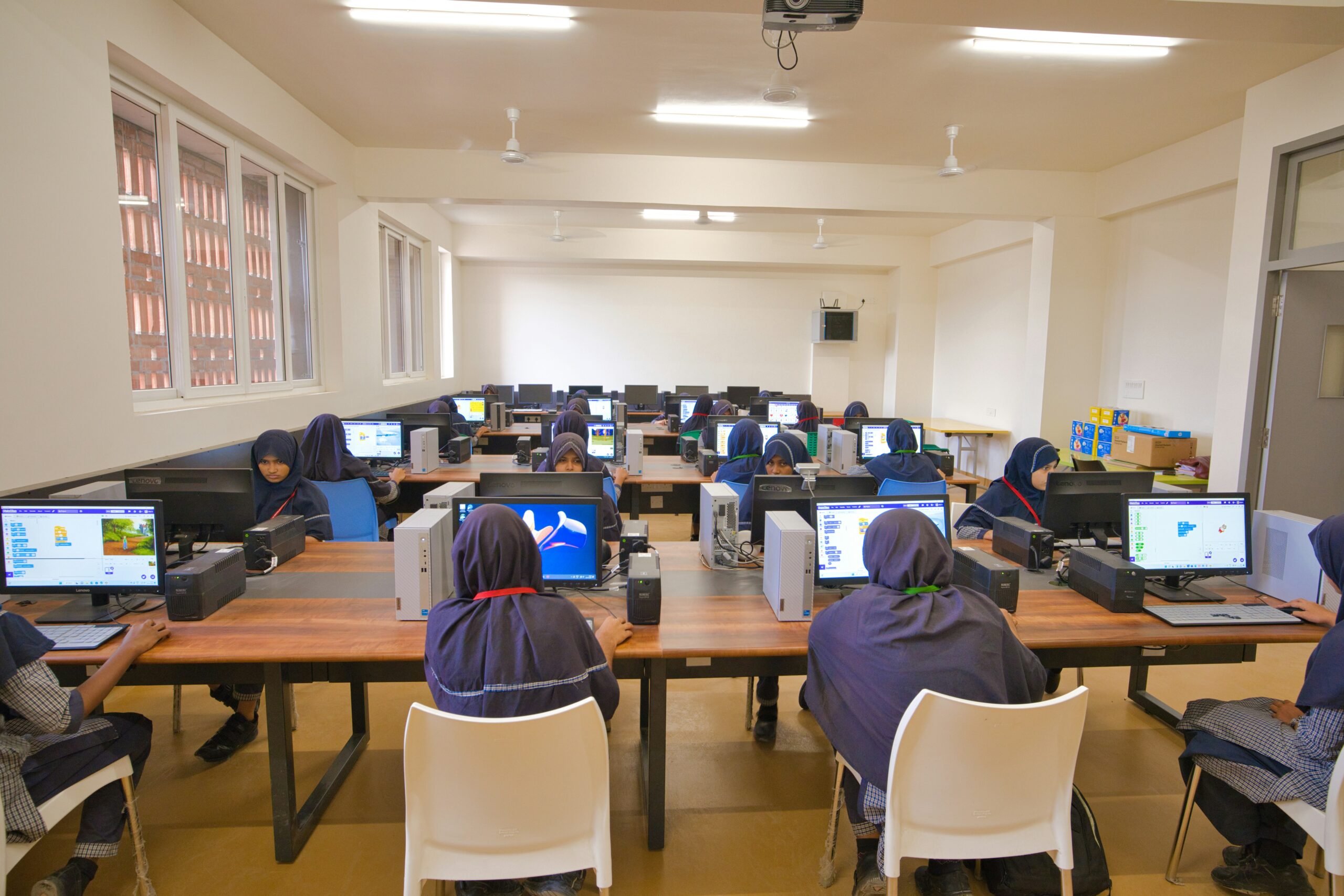
Introduction: The Great Pedagogical Shift
For centuries, the classroom remained a static environment: a teacher, a chalkboard, and a group of students. However, the dawn of the 21st century introduced a catalyst that has permanently altered the DNA of learning. Educational Technology (EdTech) is no longer an experimental add-on; it is the central nervous system of modern instruction.
The role of technology in education is not to replace the educator but to amplify human potential. By breaking down geographical barriers and personalizing the pace of learning, technology has democratized knowledge in ways previously unimaginable.

1. Personalized Learning: The End of “One Size Fits All”
Historically, education followed a factory model where every student moved at the same speed. Technology has dismantled this rigid structure through Adaptive Learning Software.
- Data-Driven Instruction: Platforms like Khan Academy or Duolingo use algorithms to identify exactly where a student struggles. If a student fails a geometry quiz, the system automatically provides remedial videos and adjusted exercises.
- Student Agency: Learners can now control the time, place, and path of their education. This “Asynchronous Learning” allows gifted students to accelerate while ensuring struggling students are not left behind.
2. Interactive and Immersive Technologies: Beyond the Textbook
The greatest challenge in education is engagement. Technology solves this by transforming passive consumption into active participation.
A. Gamification
By incorporating game mechanics—such as point systems, leaderboards, and badges—into the curriculum, educators tap into the psychological drivers of motivation. When a student “levels up” in a math app, the dopamine response mirrors that of a video game, making hard work feel like play.
B. Augmented and Virtual Reality (AR/VR)
VR allows a history student in Somalia to virtually walk through the ruins of Ancient Rome, or a biology student to travel inside a human cell. AR (Augmented Reality) overlays digital data onto the physical world, turning a standard textbook page into a 3D interactive model.

3. The Democratization of Knowledge: Global Access
Technology has effectively killed the “geographical lottery” of education. In the past, your quality of education depended on your zip code.
- MOOCs (Massive Open Online Courses): Platforms like Coursera and edX allow a student with a basic smartphone to take a computer science course from Harvard or MIT for free.
- Open Educational Resources (OER): Digital libraries and open-source textbooks have reduced the financial burden on students, ensuring that poverty is no longer an absolute barrier to high-quality information.
4. The Role of Artificial Intelligence (AI) in Pedagogy
As we move through 2026, AI is the most significant frontier in EdTech.
- AI Tutors: 24/7 AI assistants can answer student queries instantly, providing a bridge when teachers are unavailable.
- Automated Administrative Tasks: Teachers spend roughly 30% of their time grading and doing paperwork. AI can automate grading for objective tests, allowing teachers to focus on mentorship and emotional support.
- Predictive Analytics: AI can analyze patterns in student attendance and grades to predict “at-risk” students before they drop out, allowing for early intervention.

5. Bridging the “Digital Divide”: A Critical Challenge
While technology offers immense benefits, it also poses a risk: the Digital Divide.
- Connectivity: Without high-speed internet, the digital classroom is inaccessible.
- Hardware Access: There is a stark contrast between a student with a high-end laptop and one sharing a single smartphone with three siblings.
- Digital Literacy: Providing a tablet is useless if neither the teacher nor the student knows how to navigate the software effectively.
For technology to truly fulfill its role, governments and NGOs must treat internet access as a basic human right, similar to water and electricity.
6. Transforming the Teacher’s Role: From “Sage” to “Guide”
One of the biggest misconceptions is that technology makes teachers obsolete. In reality, it makes them more important than ever.
The teacher’s role has shifted from being the “Sage on the Stage” (the sole source of information) to the “Guide on the Side” (a facilitator of critical thinking). In a world where Google has all the answers, the teacher’s job is to teach students how to ask the right questions and how to distinguish between “fake news” and credible data.
7. The Future of Education: Hybrid and Blended Learning
The future is not purely digital, nor is it purely physical. Blended Learning—a mix of face-to-face instruction and online modules—is becoming the gold standard.
- The Flipped Classroom: Students watch lecture videos at home (the “lecture”) and use classroom time to work through problems and projects (the “homework”). This maximizes the value of the teacher’s presence.
Conclusion: The Human-Tech Synergy
The role of technology in modern education is to provide the tools, but the heart of education remains human connection. As we integrate AI, VR, and global networks, we must ensure that these tools serve the values of empathy, critical thinking, and social equity. Technology is the engine, but human curiosity remains the fuel.